
How Woozoo's Multi-Directional Airflow Actually Works (And Why Most Fans Don't Move Air This Way)
Most fans push air in one direction. You feel a strong breeze if you stand directly in front, but the rest of the room stays still.
Woozoo fans work differently. Our multi-directional airflow system moves air along multiple planes at once, creating circulation patterns that reach corners, ceilings, and floor-level zones a traditional oscillating fan never touches. This guide explains the engineering behind that difference—how the airflow pathways actually form, why spiral blade geometry matters, and what whole-room circulation looks like when you measure it.
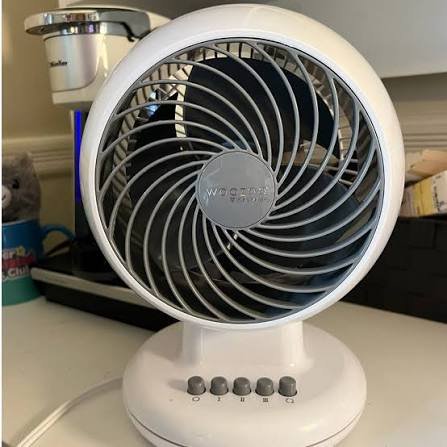
The Physics Behind Spiral-Flow Blade Design
Traditional fan blades cut a flat disc through the air. Each rotation pushes a column of air forward in a narrow cone.
Woozoo blades use a spiral pitch—the angle of attack changes continuously from hub to tip. As the blade rotates, air accelerates along curved pathways instead of straight lines. This creates a corkscrew flow pattern that spreads both horizontally and vertically as it leaves the grille.
The result is a wider, more diffuse airflow column. Instead of concentrating all the energy in a tight beam, the spiral geometry distributes velocity across a broader cross-section. Fluid mechanics principles predict that this type of distributed flow maintains momentum longer when it encounters obstacles like furniture or walls, because no single narrow jet loses all its energy on first contact.
How Oscillation Combines With Vertical Tilt
A fan that only oscillates left-to-right still leaves vertical dead zones. Most models tilt manually, so you pick one fixed angle and the upper or lower half of the room gets neglected.
Our oscillating air circulator models add motorized vertical sweep on top of horizontal rotation. The head tilts through a programmed arc—typically 20 to 40 degrees—while also panning side to side.
Why Two-Axis Movement Changes the Coverage Map
When both axes move simultaneously, the airflow traces a three-dimensional helix through the room instead of a flat arc. Cool air near the floor gets lifted toward the center of the space. Warm air pooling at the ceiling gets pushed down and mixed. The fan becomes an air circulation tool, not just a breeze generator.
You can verify this with a simple experiment: place a tissue paper strip at shoulder height in a corner opposite the fan. A single-axis oscillating fan will barely move it. A dual-axis model will cause visible flutter within two or three sweep cycles.
Remote-Controlled Speed Mapping and Circulation Modes
Multi-directional airflow needs speed control that matches the coverage pattern. Running full power constantly wastes energy and creates noise; running too low leaves circulation incomplete.
Our remote-controlled models offer five discrete speed steps plus dedicated circulation modes. Mode 1 (Sleep) runs at the minimum speed necessary to prevent air stratification overnight. Mode 3 (Normal) balances audible output with daytime whole-room mixing. Mode 5 (Turbo) pushes maximum CFM for rapid temperature equalization after opening windows or doors.
What the Remote Actually Controls
Each speed step adjusts motor RPM, but the oscillation and tilt cycles stay synchronized. The helix pattern remains consistent; only the air velocity changes. This keeps circulation predictable across all settings.
If the remote stops responding mid-cycle, the fan defaults to the last manual button input. Our separate troubleshooting resource covers common fixes for remote pairing issues, but the takeaway here is that the circulation algorithm runs independently of the control interface—the multi-axis sweep continues even if wireless sync is temporarily lost.

Measuring Whole-Room Airflow vs Point-Source Velocity
Manufacturers often publish a single CFM number—cubic feet per minute—measured directly in front of the grille. That spec tells you almost nothing about room-scale circulation.
A narrow-beam fan might deliver 500 CFM at 3 feet but drop to 50 CFM at 10 feet. A multi-directional fan might measure 350 CFM at 3 feet but still deliver 180 CFM at 10 feet because the spiral flow holds its structure longer.
The Right Metric for Whole-Room Performance
What matters is air changes per hour (ACH) across the entire room volume. For a 12×12 bedroom with an 8-foot ceiling, you need roughly 1,150 cubic feet of circulation. A fan delivering 230 CFM of sustained, diffuse flow achieves one full air change every five minutes. A 500 CFM narrow-beam fan pointed at one wall may never circulate the air behind furniture at all.
Woozoo’s spiral blade and dual-axis sweep are engineered to maintain higher CFM values at distance, which translates to faster whole-room mixing even if the peak grille-exit velocity is lower than a traditional high-speed model.
Why Airflow Geometry Matters More Than Peak Speed
A fan that blasts 600 CFM in a single narrow column will cool whoever stands in that column. Everyone else in the room gets leftover turbulence.
Multi-directional airflow spreads velocity across a wider area and maintains circulation through the entire volume. The engineering difference is spiral blade pitch plus synchronized two-axis movement. The practical difference is a room that feels evenly conditioned instead of having one cold corner and three warm ones.
When you compare models, look past the peak speed spec. Ask how the airflow disperses at 8 or 10 feet, whether the sweep pattern covers vertical space, and how many discrete speed steps let you match output to real conditions. Those details determine whether you get whole-room circulation or just a more expensive desk fan pointed at your couch.
Common Questions About Multi-Directional Circulation
It moves air, which increases evaporative cooling from your skin and prevents hot or cold zones from forming. The fan itself does not lower air temperature—physics does not allow that—but by eliminating stratification it makes the room feel several degrees more comfortable and helps your HVAC system reach setpoint faster.
You will feel stronger velocity within 6 feet of the fan. Beyond that distance, the effect becomes indirect circulation rather than a direct breeze. The goal is to eliminate stagnant pockets and keep air mixing continuously, not to deliver hurricane-force wind to every square foot.
Spiral blades typically produce a lower-frequency hum instead of the high-pitched whine from flat blades cutting sharply through air. Total decibel output depends on speed setting, but the sound signature is generally perceived as less intrusive because it lacks the repetitive chopping tone.
Yes, often better than a single-direction fan. The vertical tilt component lets you aim part of the sweep cycle toward the ceiling to break up thermal layers. In L-shaped or open-concept spaces, position the fan at the junction point and let the oscillation cover both zones over time.
The motors are rated for continuous operation. Running oscillation constantly does not reduce lifespan as long as the fan is not subjected to voltage spikes or kept in a high-humidity environment. Normal residential use, even year-round, falls well within design parameters.
The oscillation and tilt motors add roughly 3 to 5 watts to the total draw. At typical runtime hours, that translates to less than two dollars per year in added electricity cost. The energy required to move the head back and forth is negligible compared to the main airflow motor.